
Drywall Repair Materials: What a Patch in a Gaffney Home Is Made Of
A quote for a drywall repair can read like a parts list: five-eighths board, setting compound, mesh, bead. If those words are unfamiliar, it is hard to tell whether the plan fits the damage. Below, one material at a time, is what each piece of a repair does and when it earns its place, so the plan for your wall is clear before the work starts.
Which board goes into the wall?
Drywall is a sheet of gypsum sandwiched between paper facings. For repairs the rule is simple: the new piece matches the thickness of what is already there, so the face sits flush.
- Half-inch standard
- The usual board on interior walls in houses from the 1960s onward, including the many Gaffney homes built in the 1970s.
- Five-eighths
- Thicker and stiffer. Common on ceilings, where it resists sagging between joists, and in its Type X form on garage walls and ceilings shared with living space, where building codes call for extra fire resistance.
- Moisture-resistant
- Sheets with a water-resistant facing for bathrooms and laundry areas. In tub and shower surrounds that get wet directly, cement board is used behind tile instead.
- Quarter-inch
- Thin, flexible sheets used to cover a sound but badly cracked plaster wall, or to shim a patch out to match thicker plaster.
Older plaster walls are usually thicker than any single sheet, so a drywall patch in plaster is shimmed with strips behind it, or built up with compound, until it meets the surface around it.
What is joint compound, and why are there different kinds?
Compound, often called mud, fills seams and holes and builds the finished surface. Two families matter:
- Setting compound
- Sold as a powder and mixed with water. A chemical reaction stiffens it on a clock, and the bag says how long: 20, 45 or 90 minutes. It shrinks little, bonds hard and is not bothered by humidity, so it is the go-to first coat for deep fills, plaster and crack repairs.
- Pre-mixed all-purpose
- Ready in the bucket and dries as the water evaporates. Easy to spread and sand, it is used for taping and middle coats. In a humid Upstate summer it can take much longer to dry.
- Lightweight topping
- A softer pre-mixed mud saved for the last skim layers. It sands easily to a smooth finish, but it is too soft to bed tape or fill deep holes.
A good repair often uses more than one: setting compound to fill and bed, then topping to finish.
Paper tape or mesh: which one holds better?
Tape keeps a seam or crack from opening again. Paper tape is stronger and does not stretch, so most finishers reach for it on ordinary joints and in corners that fold inward. It has to be bedded in a wet coat of compound.
Fiberglass mesh comes with a sticky back and goes on without any wet bed underneath, which suits irregular cracks and plaster repairs. It stretches slightly, so it is paired with setting compound, which is strong enough to make up for that.
Pre-made patches, a mesh square with a metal plate or a piece of board with paper flanges, save time on small and fist-sized holes. Bigger openings get a cut piece of board instead.
Why do outside corners get metal or vinyl bead?
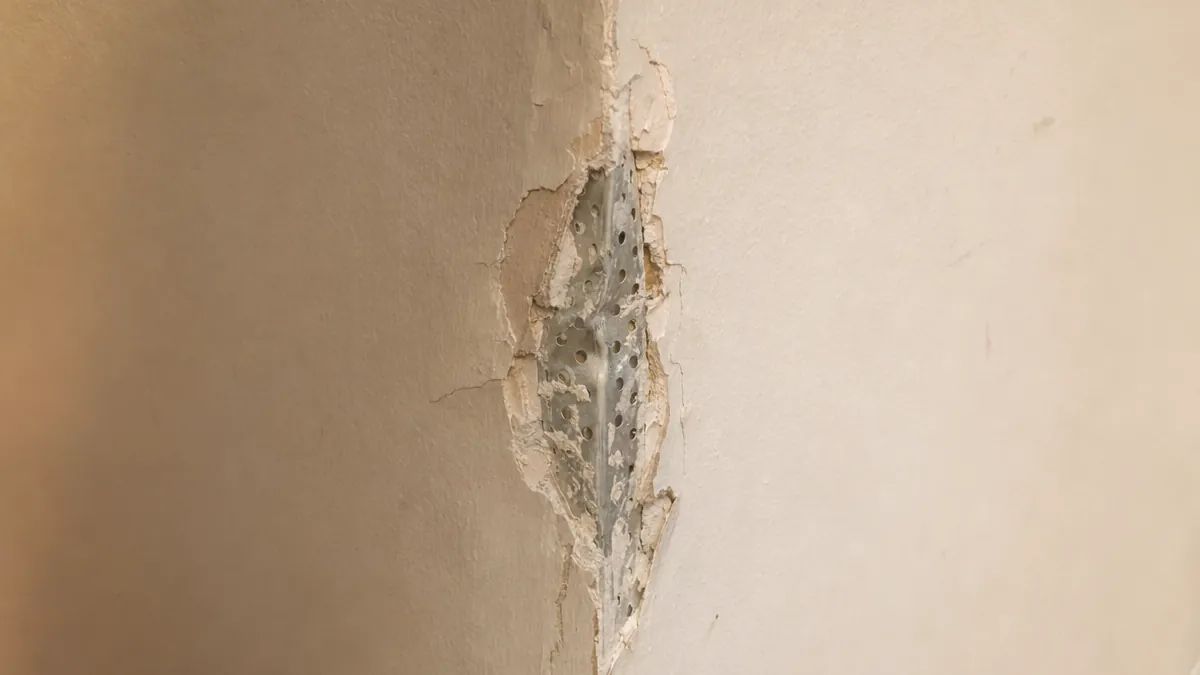
Every outside corner, where two walls meet at a point, is wrapped in corner bead. Older houses mostly have perforated metal bead nailed on and covered in compound. When it gets hit by furniture or a vacuum, the metal dents and the finish breaks away, as in the photo above.
A bent stretch of bead gets snipped out and swapped for a new length, since mudding over crooked metal leaves a bulge. The new piece is frequently paper-faced metal or vinyl, glued in with compound rather than nailed, and it resists cracking along the edge.
Which screws and fasteners belong in a repair?
Coarse-thread drywall screws go into wood studs and joists; fine-thread screws are for metal framing. A screw grips the framing much more securely than a nail, and the popped circles you sometimes see on older walls are usually nails that have backed out. The fix is a new screw driven a short distance from it, then the old nail is set deeper and covered.
For a patch where there is no stud, wood furring strips or purpose-made backer clips are fixed behind the edges. For loose plaster, thin round plaster washers with screws pull the old surface back against its lath.
What goes on last?
New compound and old paint absorb finish paint differently. A coat of primer evens that out so the paint dries to one sheen. Over a water mark, primer made with shellac or alkyd oil replaces plain latex, since it blocks the brown ring from creeping into the topcoat. With the primer dry, the repair is ready for paint.
Where do these materials show up on this site?
Most of these choices come down to the house: board thickness, plaster or drywall, and the texture on the wall. For the step-by-step of a typical patch, see how holes in drywall are patched, or plaster repair for older houses if your walls predate the 1940s.
Back to all repair guides.